
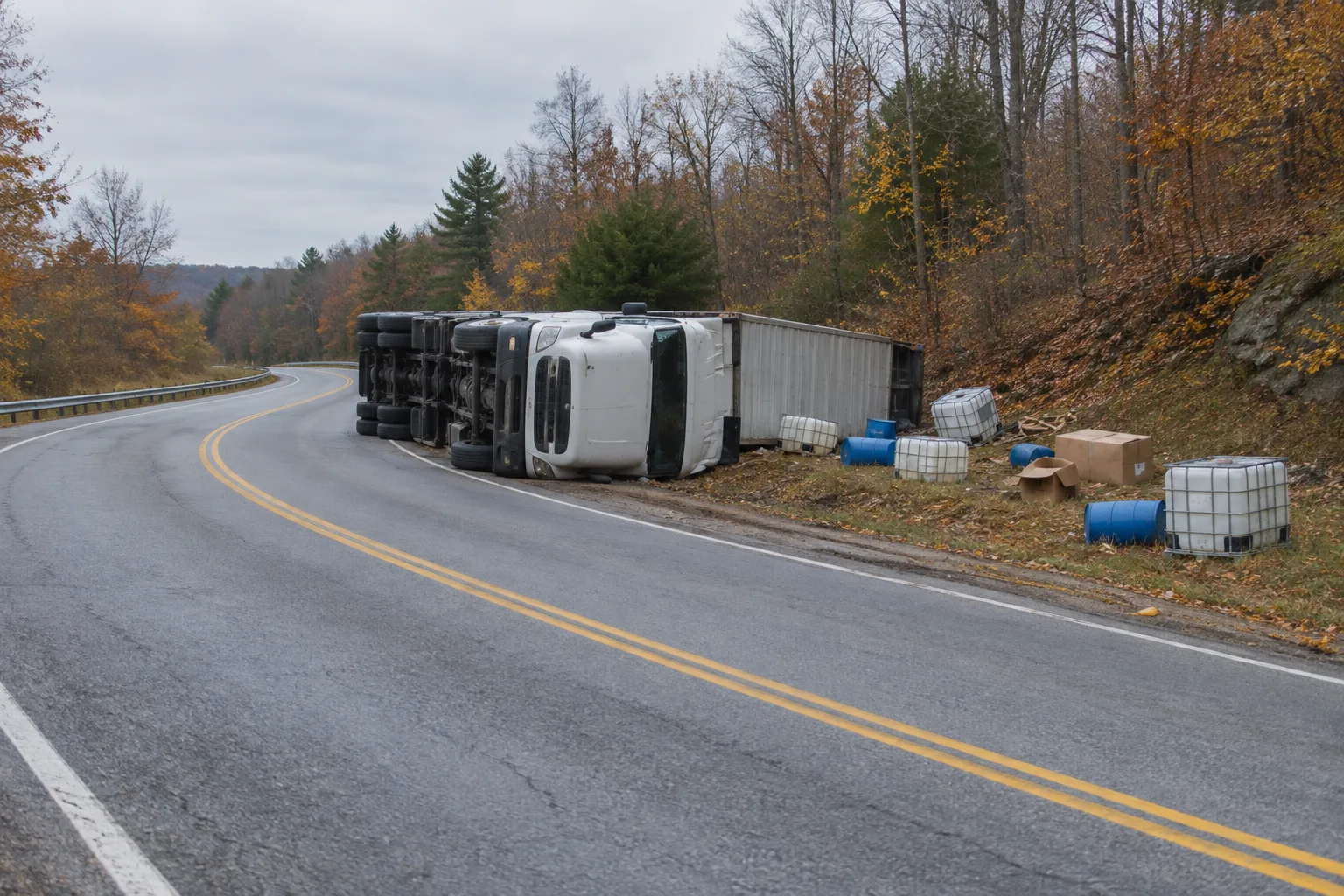
A commercial truck may roll over during a turn, after leaving the roadway, or when a sudden maneuver changes its balance. But the sight of an overturned truck does not answer the central question: what caused it? Maryland truck rollover accident liability depends on the evidence, and a rollover alone does not prove that the driver made a careless choice. For people injured in or around Bel Air, understanding the possible contributing factors can help make sense of what investigators may examine. The Law Offices of David Batzer helps people understand how evidence and Maryland injury law may apply to a crash. This article discusses potential rollover causes, evidence that may help clarify the sequence of events, and how responsibility may be evaluated. It also explains what injured people and families may want to document when it is safe to do so.
What factors can cause a Maryland truck rollover besides driver error?
A rollover can result from several interacting conditions. A driver’s speed or steering may matter, but so can a curve’s design, a sudden hazard, road surface conditions, a mechanical issue, or the way a trailer is loaded. Investigators generally look at the sequence of events rather than assuming one factor explains the crash.
Speed, turning forces, and roadway conditions
A truck and trailer have a higher center of gravity than many passenger vehicles. When a truck turns, the forces acting on the vehicle can shift its balance. A turn taken too quickly may increase rollover risk, but the road’s curve, slope, surface, and available traction can also matter. A truck may also react to a sudden obstruction or a vehicle entering its path.
Weather, standing water, loose gravel, uneven pavement, or a soft shoulder can affect control. These conditions do not automatically establish that a rollover was unavoidable or that a particular person was at fault. They are facts to consider alongside vehicle speed, steering, braking, and other evidence. In Bel Air and elsewhere in Harford County, the exact roadway and conditions at the time can be important parts of the investigation.
Maintenance and cargo distribution
A tire, suspension, steering, or brake problem may be relevant if it affected control or stability. Maintenance and inspection history can help assess a suspected vehicle issue, but records alone do not prove what caused a rollover. For more on that evidence, see truck brake maintenance and inspection records.
Cargo may also affect a truck’s balance. A load that shifts during a turn or sudden maneuver can change how weight is distributed. Investigators may consider the cargo’s placement, how it was secured, the trailer’s condition, and whether the load changed before or during the crash. No single factor, including a visible cargo problem, should be treated as decisive without examining the broader evidence.
What should injured people document after a rollover?
A truck’s final position and the surrounding scene may change as emergency responders secure the area and vehicles are moved. If it is safe and practical, photographs or notes made promptly can help preserve observations. Personal safety comes first: do not enter traffic, approach an unstable vehicle, or handle spilled cargo to collect evidence. People who are injured or shaken may not be in a position to document anything themselves.
Useful observations, when safely available, may include:
- The truck’s position, the direction it faced, and where the trailer came to rest.
- Road conditions, including a curve, slope, shoulder, debris, standing water, or visible damage to the roadway.
- Any apparent cargo movement, damaged restraints, or material outside the trailer, without approaching a hazard.
- Names and contact details for witnesses who are willing to provide them.
- The time, location, weather, and any changes noticed before the scene was cleared.
These details are observations, not conclusions about fault. Avoid guessing about speed, mechanical failures, or what a driver could see. For additional practical context, review these steps to take after a truck accident in Maryland.
Reports and witness accounts
A crash report may record initial observations, scene details, and witness information. It is one piece of evidence, not necessarily a complete account of how the rollover happened. Photographs, witness statements, vehicle and maintenance records, and other available information may add context. Read more about how a Maryland crash report may help document an injury claim.
Who may be responsible after a rollover?
Responsibility depends on what the evidence shows. A driver’s decisions may be relevant, but a review may also consider whether another party’s conduct or a vehicle or cargo issue contributed. Depending on the circumstances, potential responsibility could involve a trucking company, a maintenance provider, a cargo-related business, or another road user. Identifying a possible connection is not the same as proving legal responsibility.
Evidence may include the truck’s position and damage, witness accounts, available video, vehicle inspection and maintenance records, and information about the load. The parties who may share responsibility for a Maryland truck crash can vary with the facts; a rollover by itself does not identify who, if anyone, was legally at fault.
Maryland’s fault rules can make disputed evidence important in an injury claim. Maryland generally follows a contributory negligence rule, but how that principle applies depends on the facts and relevant law. An allegation that an injured person contributed to a crash should not be treated as established simply because it is made. For background, see Maryland’s contributory negligence rule and shared-fault questions.
In Bel Air, a careful review may need to bring together local scene observations with records and accounts from people involved. Because vehicles and cargo can be moved, and memories can fade, evidence may become harder to assess over time. A qualified attorney can explain what kinds of evidence may matter under the circumstances without assuming in advance that any one cause or party is responsible.
Frequently Asked Questions
Does an overturned truck prove the driver was speeding?
No. The final position of a truck does not, by itself, establish its speed before the rollover. Speed may be one issue investigators consider along with the road’s curve and condition, steering or braking, vehicle condition, cargo distribution, and witness accounts. Determining what happened generally requires looking at the available evidence as a whole rather than drawing a conclusion from the rollover alone.
Could a cargo shift contribute to a truck rollover?
It may. Cargo that moves can change how weight is distributed and may affect a truck’s stability, especially during a turn or sudden maneuver. Whether that happened in a particular crash depends on evidence about the load, how it was secured, the trailer, and the events leading up to the rollover. A visible cargo issue is a potential investigative clue, not automatic proof of the cause.
What if the road was wet or uneven near Bel Air?
Road conditions may be relevant, but wet or uneven pavement does not automatically determine liability. Investigators may consider the location and nature of the condition, the truck’s path, weather, available traction, and other circumstances. If it is safe, photographs or notes about the road and surrounding area may preserve observations. Bel Air-area crash conditions should be assessed in the context of the particular location and evidence.
Can I make a claim if I do not know what caused the rollover?
Not knowing the cause immediately does not answer whether a claim may be available. The cause and responsibility may require review of scene evidence, witness accounts, vehicle information, and other records. The answer depends on the facts and applicable Maryland law. A lawyer can discuss what information may help evaluate the situation, but no outcome can be promised based on the fact that a truck overturned.
How The Law Offices of David Batzer Can Help
The Law Offices of David Batzer is dedicated to helping injured people and families understand the questions that can arise after a commercial truck rollover. The firm can evaluate the available information, discuss potential sources of evidence, and explain how Maryland law may relate to the circumstances. That review may include considering the roadway, vehicle condition, cargo, witness accounts, and the roles of different parties without assuming that any single factor decides liability. If you or a family member was injured in a rollover in Bel Air or elsewhere in Maryland, contact the firm to request a free case evaluation and discuss your situation.
The information in this article is for educational purposes only and does not constitute legal advice. Contact a qualified attorney authorized to practice in the jurisdiction that applies to your matter for advice specific to your situation.