
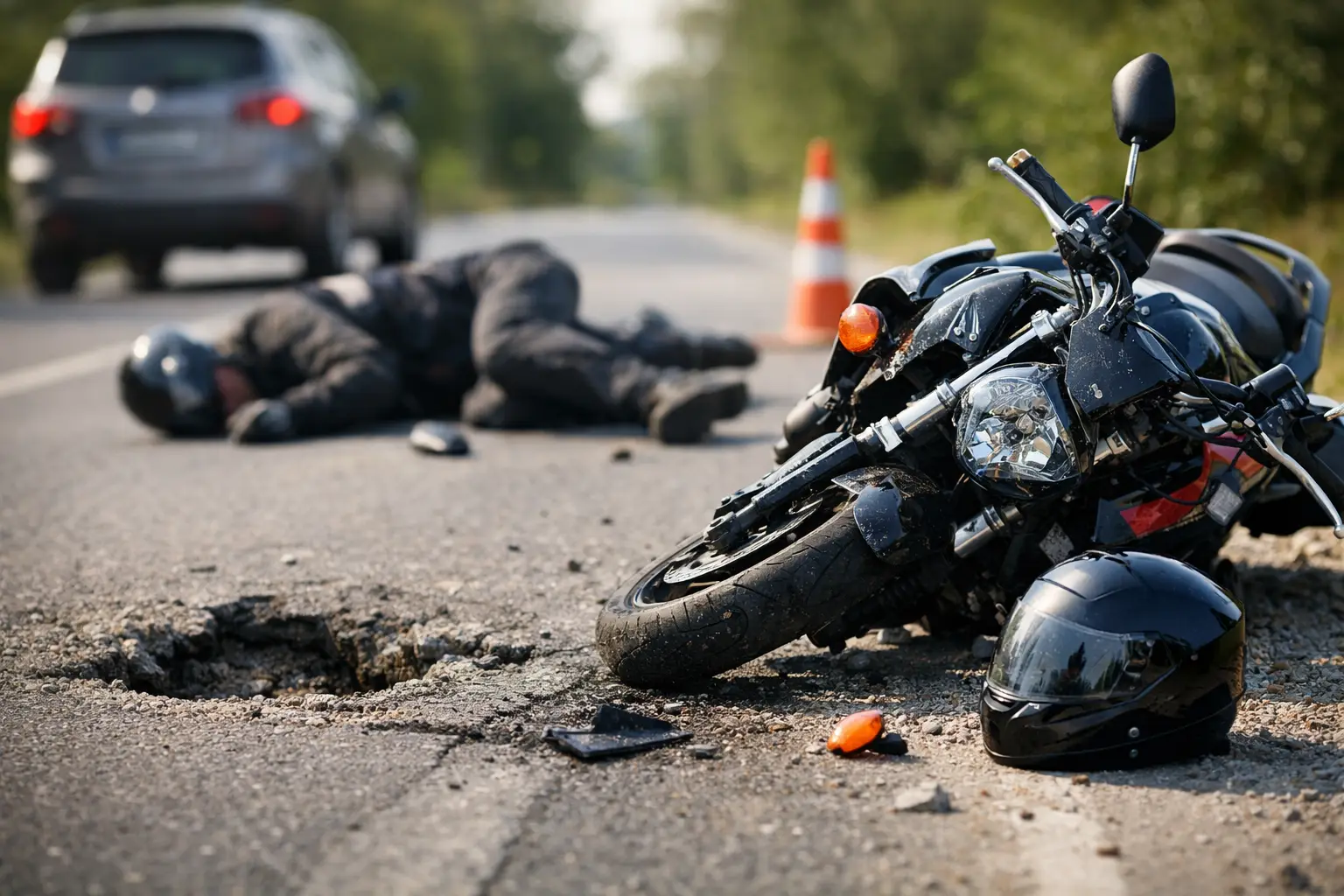
A pothole that barely shakes a car can throw a motorcyclist off balance in an instant. Loose gravel in a curve, an unmarked road cut, a steel plate, standing water, or debris left behind by a truck can create the same result: a violent crash, painful injuries, lost time from work, and an insurer looking for a reason to blame the rider. A motorcycle crash road hazard claim can provide a path to compensation, but these cases require fast action and careful investigation.
The central question is not simply whether a hazardous road condition existed. The question is who created it, who knew or should have known about it, and whether that party had a reasonable opportunity to correct the danger or warn riders. For injured Maryland motorcyclists, the answer may involve a government agency, a construction company, a property owner, another driver, or several parties at once.
When a Road Hazard Becomes a Legal Claim
Roads are not required to be perfect. Pavement cracks, changing weather, and ordinary wear do not automatically make someone legally responsible for every crash. A valid claim generally depends on proving that a dangerous condition caused the wreck and that a responsible party failed to act reasonably.
Consider a deep pothole on a heavily traveled route that has existed for weeks despite repeated complaints. Or a road construction crew that leaves an uneven surface without signs, cones, lighting, or other warnings. Those facts may support a claim because the danger was foreseeable and preventable.
The same may be true when a commercial vehicle spills cargo or leaves debris in a travel lane. In that situation, the trucking company, driver, cargo loader, or another business may be responsible. When a driver swerves into a motorcyclist while avoiding debris, that driver may still bear liability if they were speeding, distracted, following too closely, or otherwise driving carelessly.
A hazard case often has more than one layer. A poor road condition may start the chain of events, while another motorist’s reaction makes the crash worse. A thorough investigation should account for all of it.
Common Hazards That Cause Motorcycle Crashes
Motorcycles are especially vulnerable because riders have two wheels, a smaller contact patch with the pavement, and no protective vehicle frame. A condition that is merely inconvenient to a driver in a passenger car can be catastrophic to a rider.
Hazards that frequently appear in motorcycle injury cases include potholes, broken pavement, loose gravel, wet leaves, oil or fuel spills, standing water, exposed utility covers, uneven bridge joints, missing guardrails, poor lighting, and inadequate construction-zone warnings. Fresh sealant, lane grooves, milled pavement, and steel plates can also be dangerous when they are left without proper marking or maintenance.
The condition itself is only part of the case. Its location, size, visibility, duration, and surrounding warnings all matter. A shallow defect on a clear, empty road presents a different legal question than a large, unmarked road collapse around a blind curve at night.
Government Road Defects Can Involve Special Rules
If a city, county, or state agency is responsible for maintaining the road, the claim may be subject to government-immunity rules and strict notice requirements. Those deadlines can be much shorter than the deadline that applies to an ordinary injury lawsuit. Missing a notice requirement can seriously damage an otherwise strong case.
Do not assume the road belongs to the State simply because it is a major highway, or to the county because it runs through a local community. Ownership and maintenance responsibility can differ. A roadway may also contain utility work, contractor activity, or private construction that points to additional responsible parties.
This is why an injured rider should seek legal advice promptly, before the defect is repaired, records disappear, or a government notice deadline passes. A lawyer can identify the correct agency and determine whether a contractor or private company shares responsibility.
Evidence Can Disappear Faster Than You Expect
A road hazard can be patched within hours or days. Construction equipment is moved. Rain washes away fluid, gravel, tire marks, and debris. The physical evidence may be gone long before an insurance adjuster decides to take the claim seriously.
If you are able to do so safely, photographs and video should show the hazard from multiple angles, the wider road layout, lighting conditions, warning signs or lack of signs, your motorcycle’s damage, and any nearby landmarks. A photo that establishes where the defect was is often more useful than a close-up photo alone.
Witness information is equally valuable. Other riders, nearby residents, construction workers, first responders, and drivers who saw the crash may know whether the hazard had been there for days or whether someone had complained about it previously. Preserve their names and contact information whenever possible.
Other useful evidence may include the police report, 911 recordings, dispatch records, road-maintenance logs, prior complaints, inspection reports, construction contracts, traffic-camera footage, vehicle data, helmet-camera footage, and medical records. An experienced attorney can pursue records that an injured rider may not be able to obtain alone.
Do Not Let an Insurer Turn the Case Against You
Insurance companies often treat motorcycle claims differently from car accident claims. They may suggest that the rider was taking a curve too fast, should have seen the defect, failed to keep a proper lookout, or somehow assumed the risk simply by riding a motorcycle.
That approach ignores the real issue: whether the road condition was unreasonably dangerous and whether the responsible party failed to address it. A rider can be cautious, licensed, properly equipped, and following traffic laws, yet still have no safe chance to avoid an unexpected hazard.
Maryland’s contributory negligence rule makes these accusations particularly serious. If a defendant proves that an injured person contributed to the crash, even slightly, it can prevent recovery in many cases. Insurers know this and may search aggressively for statements, social media posts, or minor inconsistencies they can use against you.
For that reason, be careful about recorded statements and quick settlement offers. Do not speculate about speed, roadway conditions, or what you could have done differently while you are hurt, shaken, or still learning what happened. Medical bills and lost wages can continue long after an early settlement check is spent.
What Compensation May Be Available?
The value of a road hazard case depends on the injuries, the available insurance or other sources of recovery, the strength of the evidence, and the conduct of every party involved. There is no honest one-size-fits-all number.
A claim may seek payment for emergency treatment, surgery, hospitalization, rehabilitation, prescriptions, future medical care, lost wages, reduced earning ability, motorcycle repair or replacement, pain and suffering, and the lasting impact of scars, mobility limitations, or permanent disability. If a rider dies from crash injuries, surviving family members may have wrongful death and related claims.
A serious motorcycle crash can change a household’s finances quickly. The goal is not just to resolve the property damage claim. It is to pursue compensation that recognizes the full cost of the injury and protects the rider’s ability to move forward.
Steps to Take After a Motorcycle Road Hazard Crash
Get medical care first, even if you believe you can push through the pain. Head injuries, internal injuries, and soft-tissue damage may not be obvious at the scene. Prompt treatment also creates a record connecting the crash to your injuries.
Report the collision, preserve the motorcycle and damaged gear, and avoid having the bike repaired or discarded until it has been documented. Save your helmet, jacket, gloves, and boots. Damage patterns can help show how the crash occurred.
Then act quickly to protect the evidence and determine who is responsible. Batzer Law represents injured Maryland riders and families in serious motorcycle accident claims, including cases involving dangerous road conditions and aggressive insurance defenses.
A dangerous roadway should not leave an injured motorcyclist carrying the financial burden alone. The sooner the facts are preserved and the right parties are identified, the stronger your position can be when it is time to demand fair compensation.