
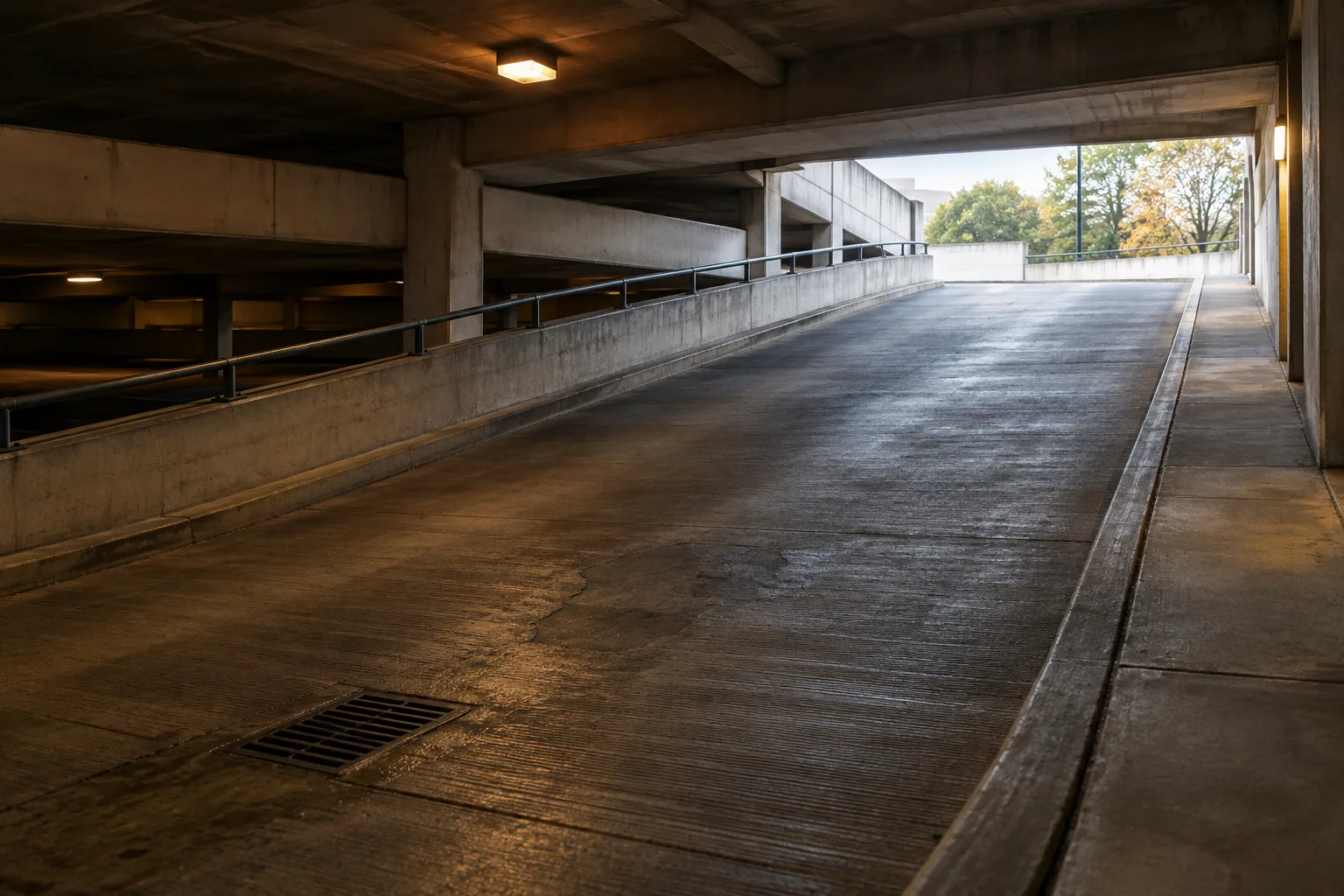
A sloped garage ramp may look like a routine route between parking levels, but it combines a grade, vehicle traffic, changing light, and water runoff. If a person dies after falling there, families may ask whether the surface, drainage, lighting, or pedestrian route contributed. A fatal parking garage fall premises liability Maryland investigation may need to explain how these conditions interacted—not simply whether the floor was slippery. The Law Offices of David Batzer can help families understand the questions a premises investigation may consider. This article reviews ramp hazards, scene evidence, and how Maryland wrongful-death issues differ from the work of determining how a fall occurred.
Why a parking-garage ramp can complicate a fatal fall claim
A flat-floor slip often centers on a localized spill or defect. A ramp adds direction and momentum: its incline can affect footing, while vehicles and pedestrians may share a narrow area or cross at turns. A change in grade, uneven transition, worn coating, or broken surface can matter alongside any moisture. The question is not whether a ramp is inherently unsafe, but whether its actual condition and use created a foreseeable risk that reasonable care could have addressed.
Property control and maintenance may also require closer examination. A garage operator, property owner, maintenance contractor, or another party may have different responsibilities depending on the arrangement and facts. The layout, inspection practices, repairs, and pedestrian route can all matter when assessing responsibility. For a broader overview of Maryland parking-lot and sidewalk accident liability, readers can consider how property conditions and upkeep fit into premises-liability questions.
How slope, wear, and drainage may interact
A ramp’s grade can make water or other substances flow toward low points, seams, drains, or landings. If a drain is blocked, poorly placed, or unable to handle runoff, standing water may remain on a route where people walk. Surface wear can reduce texture or create a rough, uneven transition; a slope by itself does not establish a defect, and the relevant details depend on the site and applicable standards.
The surrounding design matters too. A pedestrian path that is unclear, interrupted, or close to moving vehicles may affect how a person uses the ramp. In Bel Air, MD, as elsewhere, investigators may look at the complete route—from the parking space or stairwell to the point of the fall—rather than isolating one patch of pavement.
What scene evidence can show about a garage-ramp fall
Conditions can change quickly after an incident. Water may dry, a surface may be cleaned or repaired, and lighting or barriers may be adjusted. Photographs and video can help document the setting, but they are most useful when considered with context: the camera angle, time, weather, traffic, and route being used. Families may find it helpful to understand what evidence of parking-lot conditions and surveillance in Bel Air can reveal about pavement, lighting, markings, and recorded activity.
- Dated images showing the ramp surface, slope, drains, puddles, transitions, and nearby walking routes.
- Available surveillance footage showing movement through the area before and after the fall.
- Maintenance, cleaning, inspection, or repair records that may clarify what was known about recurring conditions.
- Lighting information and photographs taken from the same approach or viewpoint as the pedestrian route.
- Weather or other site-condition information that helps explain whether moisture was present and where it traveled.
A photo of a wet area, on its own, may not establish how long it was there or why it formed. Video may not capture the precise point of a fall, and a camera can omit the ramp’s slope or the person’s approach. Records and images should be interpreted together rather than treated as conclusive proof by themselves.
Preserving photographs and video
Original files can preserve timestamps and other context that may be lost when an image is edited, compressed, or shared through an app. A family might note when and where a photograph was taken and retain the unedited version. Surveillance systems may overwrite footage as part of ordinary operations, so identifying potentially relevant recordings promptly can matter. General steps to preserve evidence after a Maryland fall may need to be adapted when the injured person cannot document the scene personally.
Maryland wrongful-death issues are separate from ramp investigation
A premises investigation asks what conditions existed, who controlled or maintained the area, and whether those conditions may have contributed to the fall. A wrongful-death claim raises separate questions, including who may bring a claim and what losses may be considered under Maryland law. These questions should not be collapsed into a single assumption that a dangerous-looking ramp automatically establishes liability or claim eligibility.
Eligibility depends on Maryland’s wrongful-death rules and the relationship between the deceased and the person bringing the claim. Families can review information about which relatives may bring a Maryland wrongful-death claim to understand why not every relative necessarily has the same legal status. A related claim may also involve different parties or legal questions, depending on the circumstances.
Damages are another distinct issue. Evidence about the ramp can help address how the event happened, while the types of losses considered in a wrongful-death matter depend on applicable law and case-specific facts. The topics are connected, but evidence of a surface condition does not by itself determine damages. A separate overview of the types of damages available in a Maryland wrongful-death case explains that issue at a general level.
For a Bel Air family, the relevant court and procedures can depend on the parties, claims, and applicable venue rules; Harford County context does not make every case procedurally identical. Maryland law may change, and legal standards vary by location. A lawyer can assess how the facts and current law apply to a particular matter.
Frequently Asked Questions
Does a wet parking-garage ramp automatically prove negligence?
No. Moisture alone does not establish that a property owner or operator failed to use reasonable care. The source and duration of the water, the ramp’s condition, drainage, warnings, inspections, and who controlled the area may all matter. A careful review considers the circumstances together, including whether the condition could reasonably have been identified and addressed under the facts and applicable Maryland law.
Can surveillance footage help explain how a fatal fall happened?
It may. Footage could show the person’s route, lighting, nearby activity, or whether a condition was visible at a particular time. However, cameras may have blind spots, limited image quality, or no view of the precise location. Video is one part of the evidence and may need comparison with photographs, maintenance records, and the physical layout of the ramp.
Who may be responsible for a fall on a garage ramp?
Potential responsibility depends on who owned, controlled, operated, or maintained the relevant area and on the circumstances of the incident. More than one party’s role may need examination, but a party is not responsible merely because it is connected to the property. A premises-liability assessment considers applicable duties, notice of a condition, and evidence about how the fall occurred.
Is a wrongful-death claim the same as a claim about the ramp’s condition?
They address related but distinct issues. Evidence about the ramp may help determine whether a property condition contributed to a death, while a wrongful-death claim also involves who may bring the claim and what losses may be considered. Maryland law governs those questions, and eligibility and damages depend on the specific facts. A lawyer can explain how the issues may fit together.
How The Law Offices of David Batzer Can Help
The Law Offices of David Batzer is dedicated to helping families understand the evidence and legal questions that may follow a fatal fall. A review may consider the ramp’s slope and surface, drainage and lighting, pedestrian routes, available photographs or video, and the separate requirements of a Maryland wrongful-death claim. The firm is committed to fighting for families’ rights while recognizing that each situation depends on its own facts and applicable law. If a fall occurred in Bel Air or elsewhere in Maryland, contact The Law Offices of David Batzer to request a free consultation or case evaluation and discuss your circumstances.
The information in this article is for educational purposes only and does not constitute legal advice. Contact a qualified attorney authorized to practice in the jurisdiction that applies to your matter for advice specific to your situation.