
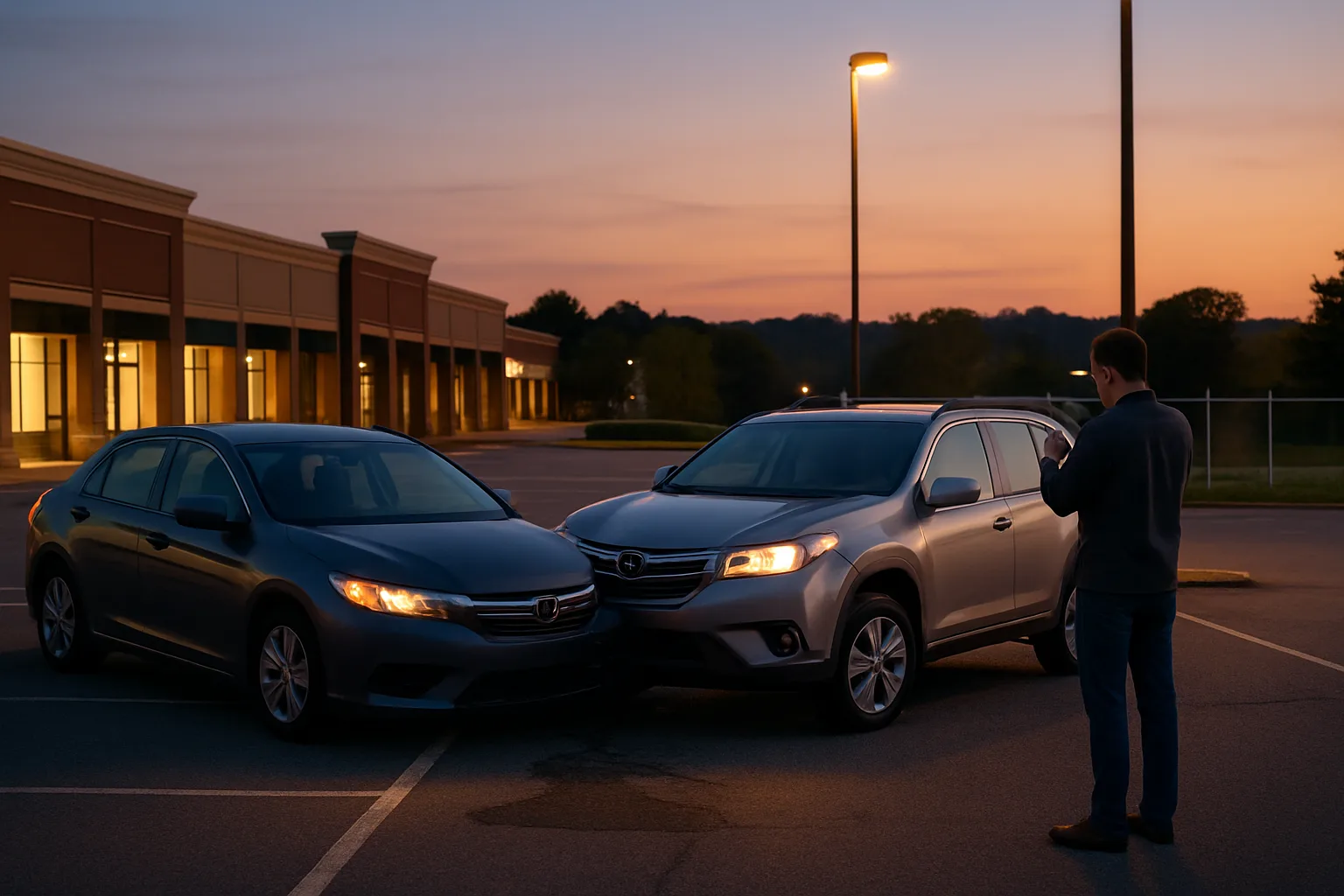
Parking-lot crashes often look like straightforward fender-benders. One driver may have been backing out, turning across a lane, or failing to notice another vehicle. But what if poor lighting, faded markings, a blocked sight line, damaged pavement, or a malfunctioning gate also played a role? For someone searching for a Bel Air parking lot accident lawyer, that distinction can affect what evidence matters and which parties may need to be investigated.
The property owner is not automatically responsible simply because a collision occurred on the premises. Generally speaking, liability depends on who controlled the area, whether an unsafe condition existed, whether the responsible party knew or should have known about it, and whether that condition contributed to the crash or resulting injuries. The Maryland parking lot accident liability analysis may therefore involve both traffic conduct and the condition of the property.
The Law Offices of David Batzer can help readers understand the issues that may arise after a crash in Bel Air, MD. This article explains when a property-owner theory may apply, what to photograph and report, how driver and premises fault can overlap, and when preserving evidence or obtaining legal guidance may be important.
When a Bel Air Parking Lot Accident Lawyer May Examine Owner Fault
A parking lot is not automatically unsafe because a collision happened there. Property owners and operators generally are not insurers against every accident. However, a Maryland parking lot collision claim may involve premises liability when a condition on the property created an unreasonable hazard and contributed to the event.
Conditions that may require investigation
Examples can include:
- Poor or nonfunctioning lighting that made vehicles, pedestrians, signs, or lane boundaries difficult to see.
- Faded, missing, confusing, or poorly positioned lane markings and traffic controls.
- Damaged pavement, potholes, debris, standing water, or abrupt elevation changes.
- Landscaping, stored materials, signs, parked vehicles, or structures that blocked sight lines.
- A malfunctioning entrance or exit gate that moved unexpectedly or failed to provide adequate warning.
The relevant question is usually not whether the property owner caused the collision directly. It is whether the owner, operator, maintenance company, or another responsible party failed to address a condition that foreseeably contributed to the crash. Control and notice can be important. For example, a business that leases space may have maintenance duties different from those of a property owner, depending on the lease and the area involved.
For additional background, review the discussion of premises liability for unsafe parking-lot conditions. In Bel Air, MD, an attorney may examine maintenance records, prior complaints, inspection practices, lighting conditions, and whether the condition was reported before the collision.
What Should You Photograph and Report After a Parking-Lot Crash?
Conditions can change quickly. A vehicle may be moved, a temporary obstruction may disappear, a damaged gate may be repaired, or lighting may be different during daylight and nighttime hours. If it is safe to do so, photographs and notes can help preserve the scene as it appeared close to the time of the collision.
A practical evidence checklist
Consider documenting:
- The overall layout. Photograph entrances, exits, drive aisles, parking spaces, intersections, ramps, and the position of each vehicle before anything is moved, if possible.
- Traffic controls. Capture stop signs, arrows, yield signs, speed-control devices, one-way indicators, lane markings, crosswalks, and any signs that are missing, blocked, faded, or difficult to interpret.
- Visibility and lighting. Photograph lights, dark areas, shadows, obstructions, sight lines, and the scene from each driver’s approach. Conditions may need to be documented at a similar time of day if lighting is disputed.
- Surface conditions. Photograph potholes, cracks, uneven pavement, debris, water, ice, oil, or other defects, including a wider image showing where the condition was located.
- People and recordings. Write down witness names and contact information when voluntarily provided. Ask whether nearby businesses, garages, security offices, or homes may have surveillance cameras.
- Vehicle damage and final positions. Photograph damage from multiple angles and note whether either vehicle was moved before photographs were taken.
You can find additional guidance about preserving evidence after a Maryland collision. Avoid altering, enhancing, or deleting original photographs and videos. In a Bel Air, MD parking lot, a property manager or business may control surveillance footage, and retention practices can vary. A prompt request to preserve relevant footage may be useful, although it does not guarantee that footage exists or will be available.
What to tell responding officers
If law enforcement responds, describe the exact location and explain any condition you believe affected visibility, movement, or vehicle control. Mention damaged pavement, confusing markings, poor lighting, blocked sight lines, gates, witnesses, and cameras without guessing about facts you did not observe. The role of a Bel Air crash report can be important, but a report may not resolve every question about fault or establish the complete condition of the property.
How Driver Fault and Property-Owner Fault Can Overlap
A parking-lot collision can involve more than one contributing factor. One driver may have been moving too quickly for the conditions or failed to keep a proper lookout. At the same time, poor lighting or unclear markings may have made it harder to identify another vehicle’s path. Determining responsibility requires examining how each alleged act or condition contributed to the collision and the claimed injuries.
Maryland’s contributory negligence rule can make the injured person’s conduct a significant issue. Read this plain-language explanation of Maryland’s contributory negligence rule. In general terms, an insurer or defendant may argue that the injured person’s own lack of care contributed to the crash. The effect of that argument can depend on the facts, the evidence, and the claims being pursued.
Common mistakes after a parking-lot collision include:
- Assuming the other driver is the only possible responsible party before examining the scene.
- Leaving before photographing signs, markings, pavement, lighting, or vehicle positions.
- Failing to ask about cameras because the collision occurred on private property.
- Giving a recorded statement that guesses about speed, visibility, or who had the right of way.
- Posting photographs or comments online that do not accurately reflect the event.
- Treating the absence of immediate symptoms as proof that no injury occurred.
For general guidance on next steps after a Bel Air car accident, readers can review safety, reporting, documentation, and medical follow-up considerations. Depending on the circumstances, an attorney may also evaluate whether a business, property owner, maintenance contractor, gate operator, driver, or multiple parties should be investigated. Maryland law applies to a Bel Air claim, but legal standards and procedures can vary by location and may change over time.
Frequently Asked Questions
Is a property owner automatically liable for a parking-lot collision in Maryland?
No. Ownership alone does not establish responsibility for a crash. A claimant generally may need evidence of an unsafe condition, the responsible party’s control or duty, notice or reason to know of the condition, and a connection between that condition and the collision or injury. Driver conduct may also be examined. The facts of each Maryland parking-lot collision claim determine whether a premises-based theory is viable.
Can poor lighting support a parking lot injury premises liability claim?
Potentially, but poor lighting does not automatically establish liability. The investigation may consider whether lighting was inadequate or malfunctioning, who controlled it, whether the condition was known or reasonably discoverable, and whether it affected the driver’s ability to see a vehicle, person, marking, or hazard. Photographs taken from relevant viewpoints and information about the time of day may help clarify the issue.
What if surveillance video of the parking-lot crash is overwritten?
Surveillance systems may automatically overwrite footage, and retention periods can differ. A prompt preservation request may help identify the relevant camera, date, time range, and custodian. It is also useful to document where cameras were located and whether employees or witnesses mentioned them. An attorney can explain possible evidence-preservation options based on the circumstances, but no particular recording or result can be guaranteed.
When should someone contact a Bel Air parking lot accident lawyer?
Legal guidance may be particularly useful when injuries are serious, fault is disputed, several parties may be involved, the property had lighting or pavement problems, a gate malfunctioned, or surveillance footage may be important. It may also help when an insurer requests a recorded statement or the scene has already changed. A consultation allows the facts and available evidence to be evaluated under Maryland law.
How The Law Offices of David Batzer Can Help
The Law Offices of David Batzer is dedicated to helping injured people understand how driver conduct and unsafe property conditions may intersect after a parking-lot collision. The firm can review photographs, reports, witness information, vehicle damage, medical records, and other available evidence while considering whether a Maryland car accident or premises-liability theory may apply.
The team is committed to fighting for clients’ rights and is ready to evaluate your situation without promising a particular outcome. If you were hurt in or near a parking lot, contact The Law Offices of David Batzer for a free consultation or case evaluation. You can also review information about when to contact a Maryland car accident lawyer if responsibility or evidence is disputed.
The information in this article is for educational purposes only and does not constitute legal advice. Contact a qualified attorney licensed in Bel Air, MD for advice specific to your situation.